Is your delivery slipping through the cracks despite your team’s talent? A Work Breakdown Structure (WBS) clarifies the scope and prevents those invisible gaps that cost time, trust, and money. In just one tool, you can regain control, and deliver with clarity.
The Strategic Problem: Why Work Keeps Slipping
Delivery delays. Scope confusion. Teams stepping on each other’s toes. Sound familiar?
If your projects feel like you’re constantly reacting instead of leading, the problem isn’t your people. It’s your lack of structure. Without a Work Breakdown Structure (WBS), your “plan” is just a pile of tasks, some half-done, some duplicated, and many unassigned.
“You can’t deliver what you haven’t defined.”
A WBS solves this. It’s not admin, it’s architecture. And without it, every project is built on sand.
The Strategic Solution: What a WBS Actually Does
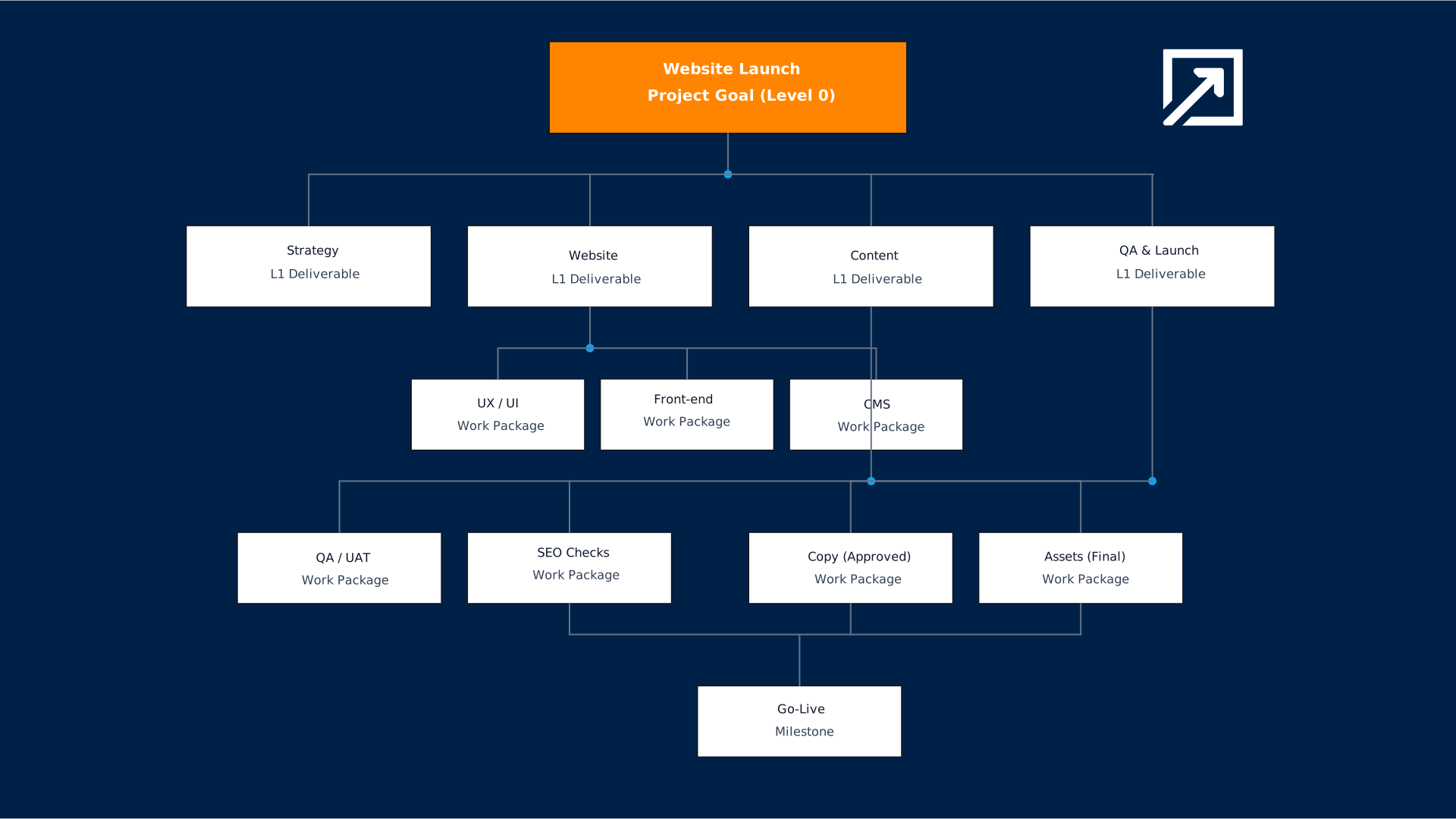
At its core, a Work Breakdown Structure is a deliverable-first map of your project. It breaks down your scope into smaller components — called work packages — that can actually be managed, measured, and owned.
Structure That Aligns People and Scope
The WBS isn’t just a task list. It’s a hierarchical tree of outcomes. From the top-level goal (e.g. Website Launch) down to each deliverable (e.g. Homepage Design, Copy Draft, QA Test), it shows what must be delivered, not just what needs doing.
“Tasks don’t align people, outcomes do.”
Clarity Without Micromanagement
Each work package should be:
Outcome-based (not “Write copy,” but “Approved homepage draft”)
Time-bound
Assigned to one clear owner
This instantly eliminates confusion about who’s doing what and when.
“If your team is guessing, your structure is missing.”
Diagram showing how undefined scope creates misalignment, missed tasks, and project confusion. Ideal for illustrating scope creep risks in project management.
The Rules That Make It Work
Every WBS follows two core principles:
100% Rule: Each level must represent 100% of the work needed for the parent outcome. Nothing more, nothing less.
Mutually Exclusive: No overlapping work, each deliverable lives in one spot.
This reduces scope creep and finger-pointing. If it’s not in the WBS? It’s not part of the project.
A Real-World Example: From Vagueness to Velocity
Before: A digital agency kept missing deadlines on a campaign launch. Tasks like “social posts” and “landing page copy” were too vague, and no one knew who owned what.
After: They mapped a WBS:
Campaign Launch → Landing Page → Email Series → Social Assets
Each item had a clear deliverable, owner, and deadline. Internal approval loops shrank. Client feedback aligned faster. The project closed two weeks early.
“The WBS isn’t paperwork. It’s protection.”
The Exit Strategy Lens
✦ Scope creep starts where structure ends. ✦ Every delay has a root: unclear ownership or undefined outcomes. ✦ WBS isn’t a tool. It’s your delivery language. Learn it. ✦ When your team stops guessing, your margin stops bleeding. ✦ Clarity doesn’t slow you down, it makes scale inevitable.
TO Sum Up
A Work Breakdown Structure isn’t for corporates. It’s for clarity-driven CEOs and team leads who are done managing chaos. Want help building yours?
➤ Book a Diagnostic Call — We’ll map your scope, identify your delivery risks, and build a WBS that protects your time and reputation.
We use cookies to improve your browsing experience, analyze site traffic, and personalize content. You can choose to accept all cookies, reject non-essential ones, or customize your preferences. For more details, please review our Privacy Policy.
Essential
Always active
These cookies are necessary for the website to function properly and cannot be disabled.
Preferences
The technical storage or access is necessary for the legitimate purpose of storing preferences that are not requested by the subscriber or user.
Analytics
The technical storage or access that is used exclusively for statistical purposes.Used to collect anonymous data on how visitors interact with our website to help us improve performance and user experience.
Marketing
Used to track visitors across websites to deliver relevant advertising and measure campaign effectiveness.