
A year ago, I left a contract at a London architecture firm because they wanted me to work in the office with minus-two-degree because the heater was broken and the new piece took three weeks to arrive. No thought for what that does to a person and its health. I said no. I didn’t fight it. I just didn’t renew the contract.
Last week I heard what happened next.
A third of the firm is redundant now after one year. Multiple major projects lost, one after another. The kind of quiet collapse that doesn’t make headlines, just empties out a floor of desks over a few months.
I’d said things, before I left. About how decisions were made. About who actually held the client relationships versus who got credited for them. About the gap between what looked organised on paper and what was actually organised in practice. Nobody acted on any of it.
A friend who still works in the same company and talks to people there told me, almost as an aside: “Honestly, that’s your ideal client now.”
She’s right. They are. But unfortunately, I can’t call them.
Not because of pride. Because the people who’d have to pick up the phone are the same people who didn’t listen the first time, when listening was free.
I think about that firm every time a founder tells me they’re confused about why a valuation came in lower than they expected or why an acquisition conversation went quiet after three promising weeks.
A business valuation doesn’t measure what your business can do. It measures what a buyer (or the market itself) can verify, document, and rely on without you in the room. Everything else, however real, however talented, gets discounted the moment nobody can confirm it survives you.
That firm never sat across from a buyer’s due diligence team. It didn’t need to. The market applied the discount anyway, just in a different currency. Not a lower offer. Lost contracts. Redundancy letters. The exact same mechanism, with no negotiating table in sight.
That’s what this article is actually about. Not “work harder.” Not “grow faster.”
Make the value visible, verifiable, and yours to transfer, not yours to perform.
The Valuation Gap Isn’t About Numbers. It’s About What Can Be Verified
Ask ten founders what their business is worth, and most will tell you a number based on revenue, or a multiple they heard a competitor got, or what they’d need to retire comfortably.
Ask a buyer (or, as it turns out, ask the market) and you’ll get a completely different answer.
Buyers don’t value what happened last year. They value what they believe will keep happening after the deal closes, without your name on the org chart.
Clients making a long-term commitment are quietly asking the same question, whether or not anyone calls it “valuation.”
That’s the gap. Not a gap in effort. A gap in evidence.
You know your business is good. You’ve lived it. A buyer has never met your business before due diligence started, and a nervous client renewing a five-year contract hasn’t either, not really. Neither will take your word for it. Both will only commit to what they can independently verify.
If the verification isn’t there (even when the value clearly is) the number drops, or the contract doesn’t renew, or the redundancy letters go out. Not because anyone is being unfair. Because that’s what happens when belief runs out and evidence was never built to replace it.

How Buyers Actually Calculate a Multiple
Most service business owners have a rough idea their company is worth “a multiple of EBITDA” — profit, times some number.
What they underestimate is how much that number moves based on structure, not size.
A well-run, structurally mature service business might trade at a healthy multiple: strong recurring revenue, distributed client relationships, a leadership team that isn’t the founder, documented delivery, clean financials.
A founder-dependent business of identical size and identical profit can sit meaningfully lower. Sometimes half. The revenue is the same. The risk profile isn’t.
Here’s why the gap is so large: a buyer isn’t just pricing your last twelve months. They’re pricing the probability that this exact level of performance continues once the person who built the relationships, holds the technical judgement, and closes the biggest deals is no longer walking in every morning.
Every unresolved dependency is a probability that gets multiplied against your revenue. And probability is a brutal thing to multiply against.
This is also where earn-outs come from. When a buyer can’t get comfortable that the business will hold without you, they don’t just lower the price, they restructure the deal so you’re financially tied to proving it, for one, two, sometimes three years after completion. You wanted to be free. Instead, you’re on an extended probation, inside a business you no longer fully control.
The Three Things a Buyer’s Due Diligence Team Is Actually Testing
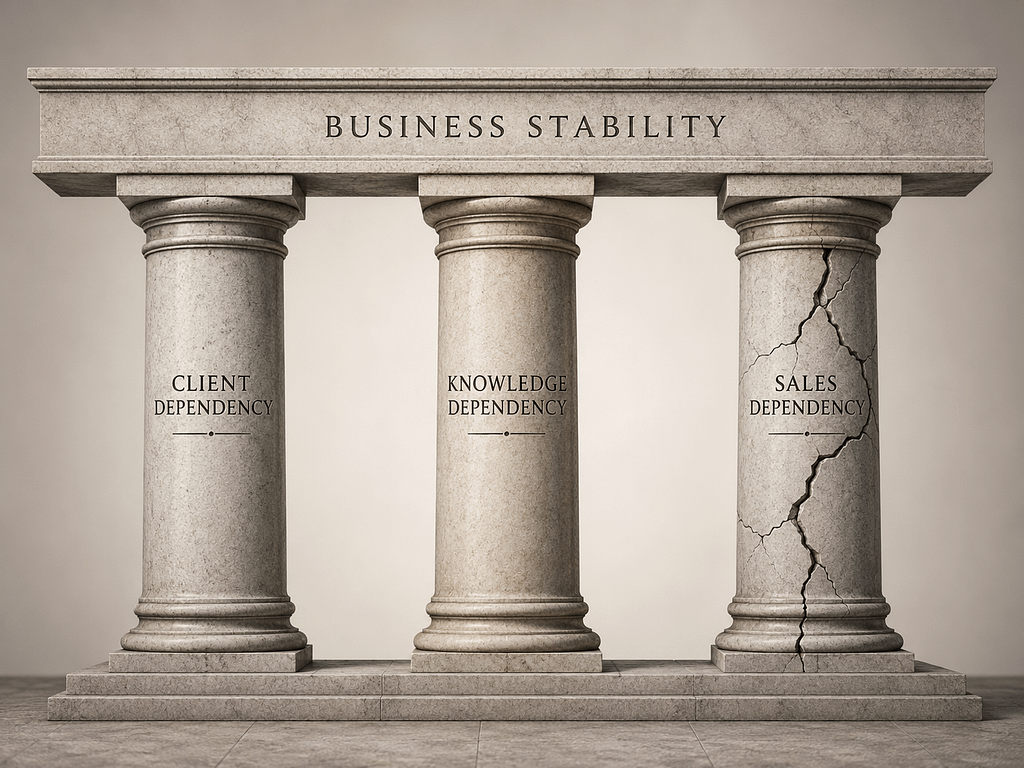
Every diligence process I’ve been close to, regardless of sector, is quietly testing the same three things: the three faces of founder dependency. The firm I opened this article with never sat through a formal diligence process. But its clients were running exactly this test on their own, informally, project by project.
- Client dependency. Do relationships belong to the firm, or to one or two individuals personally? If your biggest clients would take a specific person’s call before they’d take a call from anyone else at the company, that relationship is an asset a buyer can’t actually acquire. They can buy the company. They cannot buy being that person.
- Knowledge dependency. Does quality live in a process, or in someone’s judgement? If every important decision eventually routes back to one desk (even informally, even just as a sanity check) a buyer is really acquiring that judgement with a company attached, not the other way round.
- Sales dependency. Does new business come from a system, or from a handful of names in the market? If the pipeline would visibly dry up the quarter those people stopped actively selling, that pipeline was never really the company’s. It was on loan.
A buyer’s team will find all three, if they exist. They are trained specifically to find them. The market finds them too, eventually, just without warning you first. How? A client quietly moves the next contract to someone who looks more stable and a project goes to a competitor who can prove more continuity. The only real question is whether you find these dependencies on your own terms, or someone else finds them on theirs, after the leverage has already shifted.
Why “It’s All in My Head” Is the Most Expensive Sentence in a Data Room
I’ve sat in enough of these conversations, formal and informal, to know the exact moment a valuation starts sliding.
It’s rarely a bad set of accounts. Founders, law firms and accountants are usually meticulous about their numbers, it’s the thing they were told mattered, so it’s the thing they built well.
It’s a quieter moment. Someone asks a specific operational question:
how pricing is actually decided?
how a particular client relationship is really managed?
what happens when a senior delivery issue escalates?
and the honest answer is some version of: “That’s mainly one or two people.”
Said once, it’s a detail.
Said five times across five different functions, it becomes the entire risk profile of the business, whether the person asking is a due diligence advisor with a spreadsheet, or a long-standing client quietly deciding whether to renew.
That’s the moment the firm I left starts to make sense as a case study, not a grudge. Real capability, real judgement, sitting with too few people, undocumented, unable to be picked up by anyone else when it mattered. It held the place together for years. It just couldn’t survive being tested.
The Discount Is Bigger Than You ThinK And Rarely Stated Out Loud
Founders consistently underestimate how much of the gap is discretionary, meaning, how much of it a buyer, or a client, or the market chooses to apply, on top of the objective risk, simply because they can.
In a competitive process, with several credible buyers and clean, transferable operations, you set the terms. In a process with one interested party and visible dependency, they set the terms and there’s no competing offer, or competing supplier, to keep things honest.
I’ve watched the same underlying capability, at the same point in its life, receive wildly different treatment depending on how “provable” its continuity looked from the outside. Not because the work changed. Because the evidence did.
The uncomfortable truth: the discount is rarely stated as a line item. Nobody sends you a report that says “minus 40% for founder dependency.” It shows up as a lower multiple, a longer earn-out, a client who quietly diversifies to a second supplier, or ( as I watched happen ) a project pipeline that dries up faster than anyone predicted, followed by a floor of desks that empties out. The mechanism is invisible. The outcome it produces is not.
What Actually Moves the Number
None of this is fixed. It’s structural, which means it’s buildable.
Documented, repeatable delivery. Not a fifty-page manual nobody reads. A clear, followable account of how work actually gets scoped, delivered, reviewed and closed, clear enough that a competent hire could follow it without shadowing anyone for three months.
Distributed client ownership. Senior team members with direct, standing relationships with your most important clients, not one person, cc’d on everything, quietly still the real point of contact for all of them.
A pricing and sales process that isn’t just a handful of reputations. A repeatable way new business gets generated and closed that doesn’t collapse the moment those specific people stop personally chasing it.
Leadership depth. At least one person (ideally more) who can make a real decision, hold a difficult client conversation, and handle a crisis without waiting for someone else to become available.
Financial and operational transparency. Numbers a buyer’s advisor or a nervous long-term client, can pull apart without finding surprises.
Each one of these doesn’t just reduce risk. It converts something a buyer, or a market, currently has to take on faith into something they can verify. Verified value is the only kind that gets paid for, renewed, or trusted with the next big project.

The Three-Month Test, Applied to Valuation
There’s a question I ask every founder I work with, before we get anywhere near a spreadsheet.
If you took three months off tomorrow ( not by choice, but because you had to) what would happen to your business?
Most founders answer somewhere between “I honestly don’t know” and “it would be rough for a while.“
Here’s the valuation version of that same question, and it’s the one that actually decides your number, your client renewals, and your team’s stability all at once: if the two or three people who really hold this business took three months off starting tomorrow, would your best clients still be here when they got back?
If the honest answer is no, that answer is already priced in by a future buyer, by your most risk-aware clients, and eventually, by your own team whether or not anyone has said it to your face yet.
A Practical Valuation DIY Audit
Before you get an external opinion on what your business is worth, get an honest one from yourself. Ask the five questions a buyer’s advisor will ask anyway, just ask them earlier, when you still have time to change the answers.
- Which of my top five client relationships would survive the key person stepping back for six months, untouched?
- Could someone else in the business make a senior pricing or scoping decision today, without checking with the founder first?
- Is there a documented account of how we actually deliver as one a new hire could follow without anyone explaining it out loud?
- What percentage of new business this year came from one or two personal networks, rather than a repeatable process?
- If a buyer’s advisor (or my most important client) spent a week inside my business, what’s the one question I’d dread them asking?
That last question is usually the most honest one. Sit with it before you sit with anyone else.
The Cost of Waiting Is Not Flat, It Compounds
Here’s what makes this different from most business problems: it doesn’t stay the same size while you ignore it.
Every year a client relationship stays personal rather than institutional, it becomes more entrenched, not less. Every year a process stays undocumented, it becomes more expensive to extract, because more people have quietly built their own habits around the gap. Every quarter sales stays tied to one or two names, that concentration becomes a larger share of the number on the page — right up until one of those names, or one of those relationships, is no longer available.
The founders who close this gap most successfully are almost never the ones reacting to a crisis already under way. They’re the ones who started the structural work two or three years before they needed to — not out of fear, but because they understood that a well-built business is worth more, runs better, and gives everyone involved a genuine choice.
The businesses that struggle are the ones that find out what they were really worth at the exact moment they can least afford to hear it: a lost contract, a redundancy round, an acquisition conversation that goes quiet with no explanation. I watched it happen to a firm I knew well. Nobody there was short of talent. They were short of proof.
[IMAGE: hourglass-business-valuation-gap-closing.jpg — an hourglass beside a document with a downward-trending chart]

What You’re Actually Building Toward
I didn’t build International Exit Strategy because I think every founder should sell. Most of the founders I work with have no plan to sell anytime soon, and some never will.
A friend and referral partner said something to me recently that’s stayed with me: “It’s not about the exit. It’s about making the business better, stable, and giving you an option at the end of the day.” She’s right, and it’s the whole point. Every business should be built ready to sell, even if it’s never going to be sold because the discipline that makes a business sellable is the same discipline that makes it resilient, bankable, and calm to run.
I think about that architecture firm often, not with satisfaction, with something closer to grief. Good people, real talent, a business that could have been genuinely strong. It just never built the parts of itself that could survive being tested. Nobody made them prove it, until the market did, all at once, without warning.
That’s what a valuation gap actually is. Not a lack of value. A lack of proof.
Clients buy delivery. Buyers buy a business.
The difference between the two is exactly the gap this article has been describing and it’s closeable, whether or not you ever plan to test it against an actual offer.
Ready to Find Out What Your Business Is Actually Worth?
If you’ve read this far and you already know which of the five audit questions you’d dread being asked — that’s not a bad sign. That’s the most accurate diagnostic you’ll get for free today.
A Value Gap Review or Founder Dependency Audit looks at exactly where your business currently stands across client concentration, knowledge dependency, sales dependency, and leadership depth — and what specifically it would take to close the gap between what your business does and what a buyer, or the market, could currently verify.
The output is a written report and a 90-minute debrief. Specific to your business. Not a generic framework.
Book your discovery call → to find out whether a review makes sense for you.