
Are your projects a chaotic mess of duplicated work and missed deadlines?
The RACI Matrix is a simple yet powerful framework that helps leaders define exactly who does what, eliminating confusion, friction, and bottlenecks in project delivery.
Without a systematic approach, navigating project responsibilities can feel like herding cats; tasks slip through the cracks and accountability quickly becomes a blurred line. This article will show you how a RACI matrix not only clarifies roles but also enhances collaboration and drives project success.
The Real Problem: Why Ownership Confusion Is Killing Your Projects
When there’s a lack of role clarity, teams either double down on work that isn’t theirs or, worse, let critical tasks fall through the cracks. This leads to a host of common and destructive problems:
- Duplicated work: Two or more people tackle the same task, wasting valuable time and resources.
- Dropped tasks: Nobody takes ownership, and crucial activities are forgotten.
- Scope creep: Without clear boundaries, requests expand, pulling the project away from its original goals.
- Delayed decisions: It’s unclear who has the authority to approve or make a call, causing significant holdups.
And the worst outcome: clients lose trust.
In high-stakes service businesses, unclear responsibilities drain energy, kill motivation, and fracture team relationships.
As Stefania says:
“Projects don’t fail because of lack of skill, they fail when relationships break down.”
The Strategic Solution: How the RACI Matrix Works
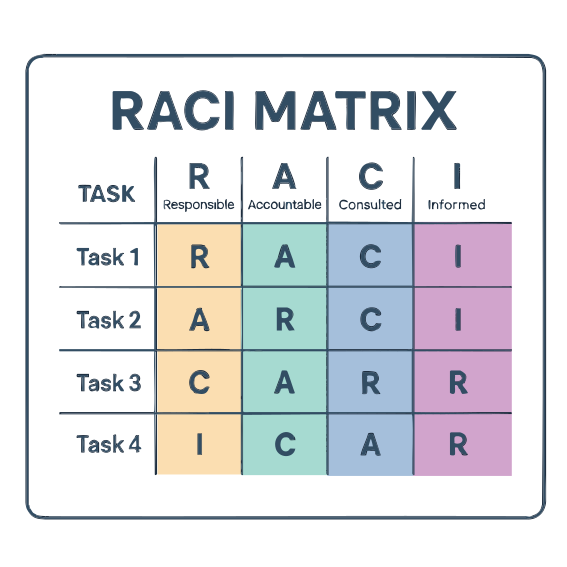
A RACI chart (or RACI matrix) is a project management tool that clarifies roles and responsibilities for every task in a project. The acronym RACI stands for Responsible, Accountable, Consulted, and Informed. Let’s break down what each term means, with practical examples.
R is for Responsible: The Doer
Who does the work?
The “Responsible” people are those who perform the work to complete project deliverables. They are the hands-on individuals taking action to get the job done. For a new product marketing campaign, the “Responsible” team might include the copywriters creating blog posts, the designers crafting ad graphics, and the social media managers scheduling posts.
✦ Tip: While it’s possible to have multiple “Responsible” people for a single task, try to avoid it unless necessary to maintain clear executive responsibility.
A is for Accountable: The Final Approver
Who owns the outcome?
The “Accountable” person is the one with the ultimate authority and answerability for a task’s completion and outcome. This single individual reviews the completed work and signs off on its quality. The buck stops here. For the same marketing campaign, the Marketing Manager would likely be “Accountable,” overseeing the entire project and giving final approval on all content before it goes live.
✦ Tip: Every task should have only one “A” to prevent any ambiguity.
C is for Consulted: The Expert
Who provides input before the work starts?
“Consulted” people are individuals whose opinions and insights are sought out before a task begins. They are typically subject-matter experts or key stakeholders who offer advice when necessary. In a software development project, a UX designer might be “Consulted” by the back-end development team for feedback on an interface issue, offering their expertise without being directly responsible for the code.
✦ Tip: Streamline your “C”s too many will slow down decision-making.
I is for Informed: The Looped-In Stakeholder
Who needs updates but not involvement?
“Informed” people are those who need to be kept up-to-date on the project’s progress but do not participate in the decision-making process. This might include senior executives, a board of directors, or external partners who need to know the overall status of the project but don’t influence the day-to-day activities.
✦ Tip: Set clear expectations for how and when they’re informed (e.g., a weekly status report or a monthly summary).
Example: RACI in a Creative Agency Launch Project
| Task | R | A | C | I |
| Finalise project scope | PM | CEO | Client | Design Lead |
| Develop design assets | Designer | Design Lead | PM | Client |
| Approve final visuals | — | Client | PM, Designer | CEO |
| Set up ClickUp workflow | PM | Ops Lead | Tech Lead | Client |
This simple matrix removes assumptions and protects delivery timelines.
How to Create a RACI Matrix in 4 Steps
A well-defined RACI matrix is a powerful document.
Follow these four steps to build one that ensures your team members understand their project roles and responsibilities clearly.
- Identify the Project Tasks and Deliverables
Start by listing all the project’s tasks, activities, and deliverables. Be as specific as possible. For instance, instead of “Develop new sales strategies,” break it down into “Analyze customer data,” “Identify key sales tactics,” and “Draft a sales playbook.” Involving key team members in a brainstorming session is crucial to create a comprehensive task list.
2. Map Out Roles and Stakeholders
List everyone who will participate, directly or indirectly, including team members, managers, and external stakeholders. Clearly define each role. At the very least, each task must have a “Responsible” and an “Accountable” person.
3. Build Your RACI Matrix
Use a spreadsheet or a project management tool to create a table. List your tasks in the first column and all roles/stakeholders in the first row. This sets up the framework for your matrix.
4. Assign Roles, Review, and Implement
For each task, assign the Responsible (R), Accountable (A), Consulted (C), and Informed (I) roles. Each task must have only one “A” to ensure clear ownership. Once complete, review the assignments with all team members and stakeholders to ensure everyone understands their roles.
By clearly defining each role, the RACI matrix helps avoid confusion, improve accountability, and streamline project management.
The Benefits of Using a RACI Matrix
RACI matrices can help various departments operate more efficiently. Here are the main benefits you can expect from implementing one:
Clarified roles and responsibilities.
Everyone knows their specific tasks and duties, which reduces ambiguity and prevents overlapping responsibilities.
Improved accountability.
A single “Accountable” person for each task ensures clear ownership and commitment to completion.
Enhanced communication.
The matrix sets clear lines of communication, ensuring stakeholders receive timely updates and feedback. Knowing exactly who to “Inform” and who to “Consult” reduces unnecessary emails and meetings.
Streamlined decision-making.
By clearly designating who makes decisions and who provides input, the RACI matrix accelerates the decision-making process, avoiding delays and ensuring more agile decisions.
RACI Best Practices for Project Success
Here are seven best practices to help you execute your projects smoothly, meet deadlines, and achieve your goals:
Assign at least one “R” and only one “A.” This is the golden rule of RACI. Multiple people can do the work, but only one should be held accountable.
Avoid overloading team members. Assigning too many “R” roles to one person can lead to burnout and create a bottleneck. Distribute responsibilities fairly.
Update your RACI matrix if things change. A RACI chart is not a static document. Schedule regular check-ins to ensure it reflects the current project state, and always inform the team of any changes.
Keep stakeholders onboard. Engage them by providing periodic updates and holding open communication channels to gather feedback.
Don’t use RACI charts for simple projects. For small projects with few tasks and team members, a simple checklist is often more efficient. RACI is most effective for complex projects.
Don’t set it and forget it. The RACI matrix should be an active document integrated into your project management resources and discussions.
Keep it simple. Your RACI chart should be clear and straightforward. Overcomplicating it (e.g., including minor administrative tasks) can reduce its effectiveness.
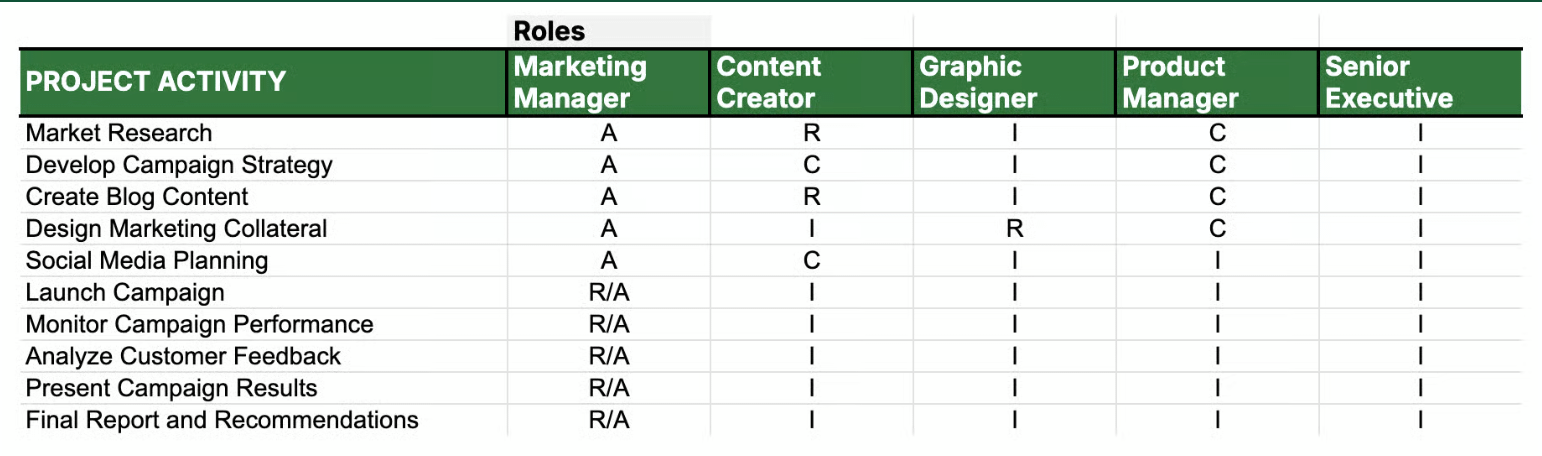
image is taken from here
Putting RACI Into Practice: 5 Actionable Steps
Here’s how to apply RACI immediately:
- Map out your delivery workflow. Find where decisions get stuck and apply RACI.
- Assign one “A” per task. Make ownership crystal clear.
- Cut the noise. Too many “C”s (Consulted) will slow down progress. Be selective.
- Share the matrix with your team. Use it as a weekly check-in tool.
- Use tools like Notion or ClickUp to visualize RACI for each phase.
To Sum Up
Clear roles don’t just deliver better results; they build a foundation of trust. If you’re ready to create that structure for your team and eliminate project chaos, it’s time to implement a RACI framework. Book a strategy call with Stefania to align your team using delivery systems that scale.
➤ Book a strategy call with Stefania to align your team using delivery systems that scale