Knowing is not doing. And most agencies never learn from their mistakes.
Your project went sideways. Timeline blown, budget exceeded, client relationship strained. It happens to everyone. But here’s what separates thriving agencies from struggling ones: what you do after the project ends.
Most agencies move straight to the next client, hoping things go better. Smart agencies pause, analyse, and build systems that prevent the same problems recurring. At International Exit Strategy, we call this “lessons learned” methodology, and it’s the difference between repeating expensive mistakes and building predictable success.
“Failure isn’t the enemy, it’s data.”
Why Projects Really Fail (It’s Not What You Think)
Everyone blames the obvious culprits: scope creep, difficult clients, unrealistic timelines. But after conducting post-mortems on hundreds of projects, we’ve discovered something interesting: projects rarely fail for technical reasons.
They fail because no one managed the human side of delivery.
Consider this scenario:
A Manchester consultancy loses a £15,000 strategy project after three months of frustration.
The surface story? “Client kept changing requirements.”
The post-mortem reality? No clear success criteria were defined upfront, weekly check-ins had no agenda, and the proposal promised outcomes without specifying how they’d be measured.
“Projects fail from relational chaos, not technical gaps.”
The cost wasn’t just £15,000.
It was team demoralisation, damaged reputation, and, most expensively, repeating identical mistakes on the next three projects.
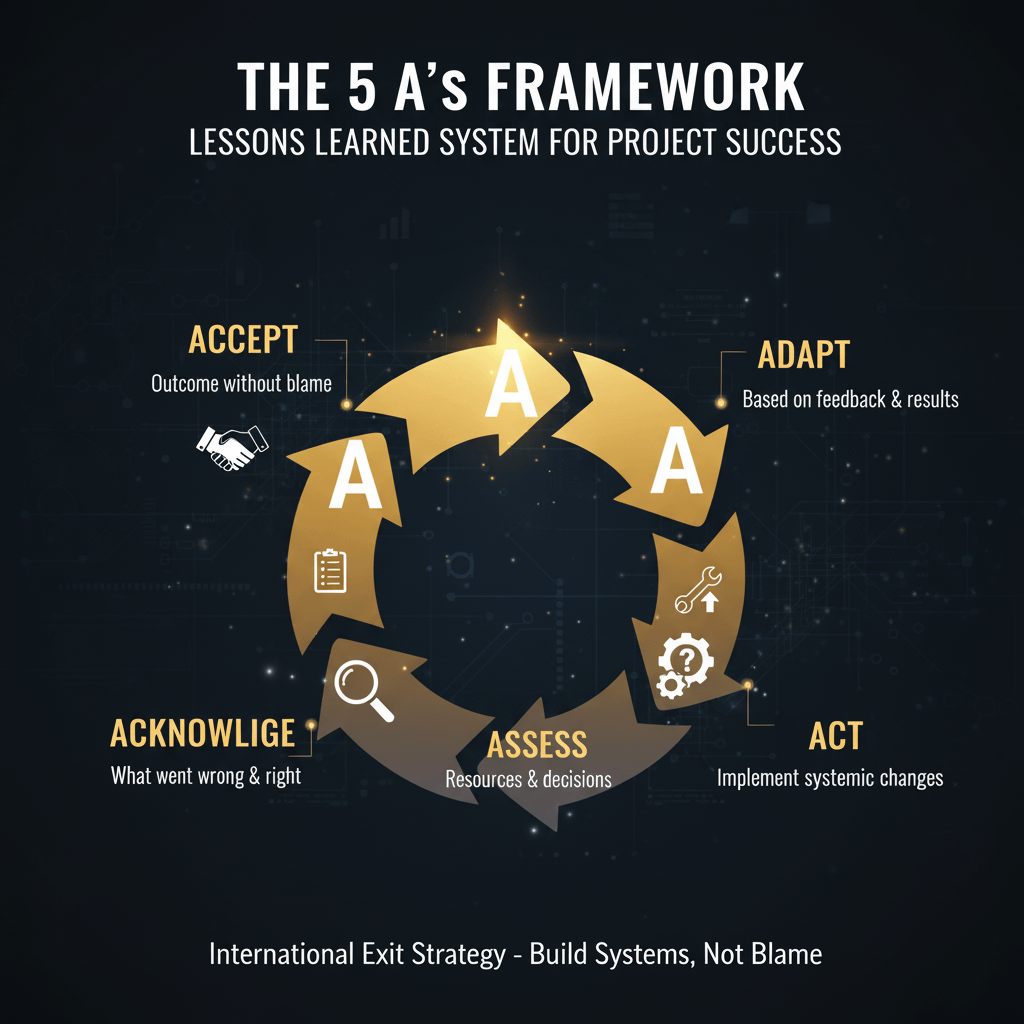
The 5 A’s of Project Post-Mortem Analysis
Traditional project reviews focus on surface metrics:
- Was it delivered on time?
- Within budget?
- Client satisfied?
These questions miss the deeper patterns that create sustainable success.
Our methodology goes further. We examine the human infrastructure behind every project outcome.
The Framework:
- Accept the project outcome without defensiveness
- Acknowledge what specifically went wrong, and what went right
Assess available resources and decision-making processes - Act with courage to implement systemic changes
- Adapt based on feedback and measurable results
“The relationship is the real execution. Trust is built before proposals ever go out.”
This framework examines five critical dimensions:
▪ Strategic Alignment – Were goals connected to actual business objectives?
▪ Communication Systems – Did meetings build confidence or create confusion?
▪ Resource Management – Was team structure adequate for scope and timeline?
▪ Stakeholder Engagement – How were expectations managed throughout?
▪ Delivery Execution – What worked, what didn’t, and why?
Case Study: From Project Chaos to Predictable Success
A creative agency approached us after losing two major clients within six months.
Each project started with enthusiasm but deteriorated into scope disputes and communication breakdowns.
The Pattern They Couldn’t See:
Every failed project followed the same trajectory.
Week 1-2: Great energy, ambitious plans.
Week 4-6: First signs of confusion about deliverables.
Week 8-10: Scope creep disguised as “collaboration.”
Week 12+: Relationship breakdown and project termination.
What Our Post-Mortem Revealed:
The problem wasn’t difficult clients or unrealistic expectations. It was a proposal process that promised everything but defined nothing. Their “collaborative approach” sounded client-friendly but created zero boundaries.
The Systematic Solution:
We restructured their client onboarding to include stakeholder mapping, success criteria definition, and explicit approval processes. Weekly meetings became strategic checkpoints with clear agendas.
Most importantly, we helped them reframe “collaboration” as “structured partnership.”
The Results After 12 Months:
Project completion rate improved from 60% to 94%.
Client retention increased significantly.
But the real transformation? The founder stopped working weekends because projects became predictable rather than chaotic.
“Simplicity is respect, for your team and your clients.”
What Most Post-Mortems Miss
Most agencies conduct post-mortems as blame sessions or surface-level reviews.
They ask safe questions that produce safe answers.
The Real Questions That Create Change:
Instead of “Was the client difficult?” ask “When did trust first start breaking down, and what was our role in that shift?“
Instead of “Did we deliver on time?” ask “Which decisions were delayed or avoided, and what systemic issues caused those delays?“
Instead of “Was scope creep the problem?” ask “What would have happened if we’d said no to specific requests, and why didn’t we?“
The Uncomfortable Truth You Can’t Skip:
Most project failures reveal system problems, not client problems.
But systems can be fixed. Patterns can be broken. That’s where the real value lies.
Real-World Applications
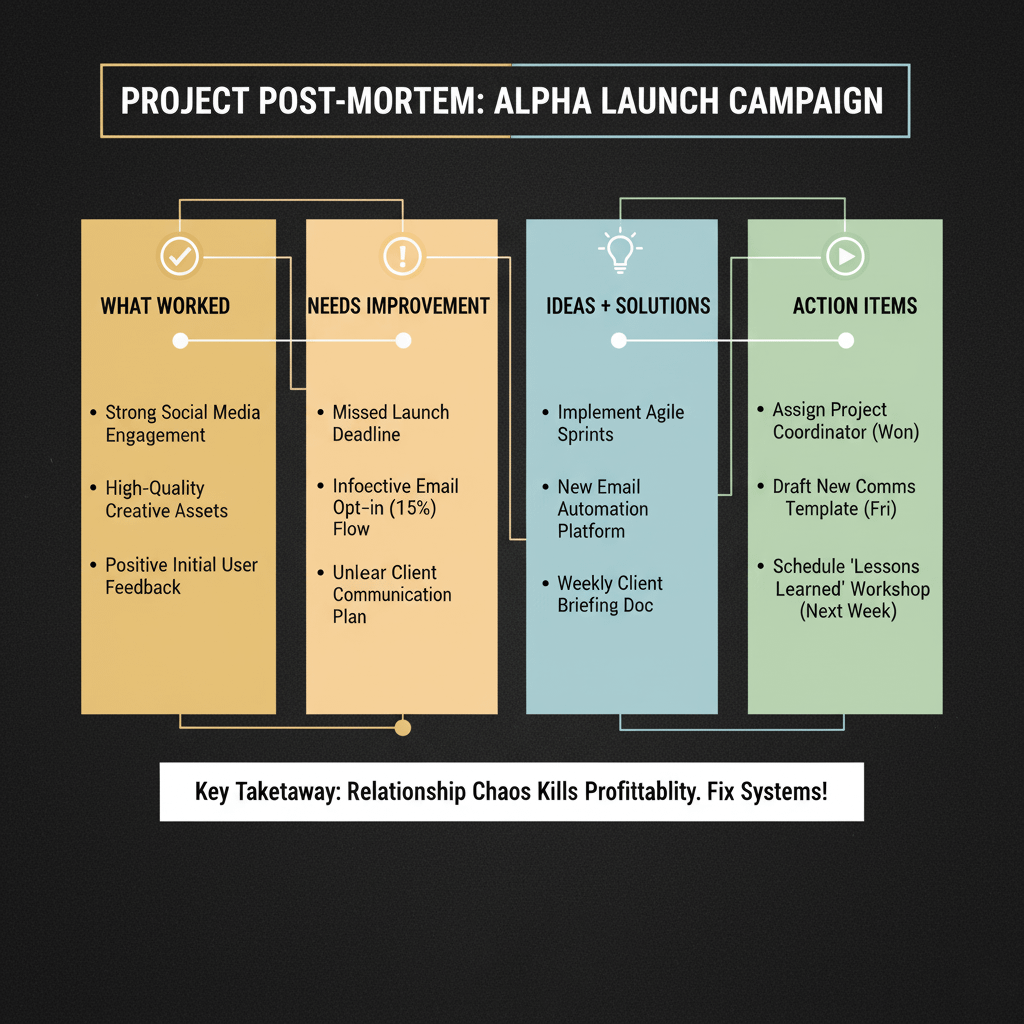
The Web Development Breakthrough
A development agency faced recurring timeline issues.
Surface analysis blamed “complex technical requirements.” Our post-mortem revealed the real issue: no one owned client communication during development sprints.
The Simple Fix:
We implemented a project coordination role and structured communication protocols. Timeline accuracy improved from 67% to 92%, and client satisfaction scores increased dramatically.
The Marketing Agency Transformation
A marketing consultancy struggled with project profitability.
Initial reaction: “Clients don’t understand the value.”
Post-mortem discovery: Their discovery phase was too brief, leading to misaligned expectations and costly revisions.
The Strategic Change: New discovery methodology with mandatory stakeholder workshops.
Result: Project profitability increased by 25%, and client relationships became smoother from day one.
“Every project must leave a legacy: insights, improvements, documented knowledge.”
Here’s What I’d Say Over Coffee
Real talk about learning from projects:
✦ Most “difficult clients” are actually confused clients.
Clear communication prevents 80% of relationship problems.
✦ Document your wins as carefully as your failures.
If you can’t explain why something worked, you can’t repeat it.
✦ Every recurring problem is a system problem.
Fix the system, not just the symptom.
✦ Post-mortems aren’t about blame, they’re about building intelligence.
The question isn’t “who failed?” but “what can we learn?”
✦ Your biggest competitive advantage isn’t your skills, it’s your ability to improve faster than your competition.
Building Your Post-Mortem Process
A Simple 4-Week Framework:
Week 1: Gather Perspectives
Interview every stakeholder separately. Ask open questions: “What surprised you about this project?” “Where did communication work well or break down?”
Week 2: Map the Journey
Document every key decision, delay, and turning point. Look for patterns, not just problems.
Week 3: Identify Success Patterns
Don’t just study failures. Analyse what went right and why. Success leaves clues too.
Week 4: Design System Improvements
Transform insights into operational changes. Update templates, processes, and communication protocols.
“Continuous improvement isn’t a buzzword, it’s the operating system of resilient businesses.”
The goal isn’t perfection, it’s predictable excellence. Each post-mortem should yield actionable improvements and replicable success patterns.

Questions That Actually Matter
For Your Next Project Review:
Relationship Dynamics:
- When did you first sense tension, and what was happening in the project at that moment?
- Which conversations created clarity versus confusion?
- What assumptions proved incorrect, and how could we have tested them earlier?
Operational Flow:
- Where did handovers between team members work smoothly or break down?
- Which processes helped delivery versus created unnecessary work?
- What decisions took longer than expected, and why?
Strategic Alignment:
- Did success criteria remain consistent, or did they drift during the project?
- How did scope changes affect both delivery and relationships?
- What would we do differently from day one?
Long Story Short
Your next breakthrough is hiding in your last failure.
Projects will always have challenges, that’s the nature of creative work. But the agencies that thrive are the ones that extract maximum learning from every experience, successful or not.
Most competitors repeat the same patterns project after project. They blame external factors and hope the next client will be different. Meanwhile, you could be building systematic intelligence that compounds across every future project.
The difference between struggling and thriving isn’t talent or luck, it’s learning velocity. How quickly can you identify patterns, implement improvements, and prevent recurring problems?
“Most founders lose margin not because of lack of talent, but because no one manages the full picture.”
Every project contains lessons. Therefore, the question is whether you’ll waste them or weaponise them.
Ready to transform your project experiences into competitive advantages? Our Post-Mortem Analysis & Future Proofing methodology helps service businesses build systematic learning that prevents recurring mistakes and amplifies repeatable successes.