“I’ll keep it in mind.” “My mind is full of thoughts.” “I need to remember that.”
Recognise these? They’re the mantras of founder dependency. Every time you say “I’ll remember,…” you’re building a business that can’t function without your brain as the central operating system.
Buyers don’t pay premiums for what lives in your head. They pay for what’s documented, replicable, and transferable.
The Mental Load That’s Killing Your Business Value
Here’s the reality most service business owners won’t admit: Your mind isn’t a filing system. It’s a blockage.
When critical processes, client preferences, project lessons and operational knowledge exist only in your head, you’ve created three catastrophic problems:
➤ Founder Dependency: The business stops when you’re unavailable ➤ Knowledge Loss: Team members leave, taking institutional knowledge with them ➤ Valuation Discount: Buyers scrutinise operational risk and slash offers accordingly
Every “I’ll remember that” is another reason why your business valuation stays stuck. PE firms and strategic buyers conduct operational due diligence precisely to identify businesses where everything runs through the founder’s mental bandwidth.
They don’t just discount these businesses. Sometimes they walk away entirely.
“Your business should be vacation-proof, not founder-dependent.”
The cost? Conservative estimates suggest founder-dependent operations reduce exit valuations by 30-50%. That’s £900,000 to £1.5M on a £3M business, lost because you relied on memory instead of systems.
Are you struggling under the weight of information overload? Learn strategies to manage mental clutter and reduce burnout.
The Exit Strategy Language Shift
Want to transform overwhelm into operational excellence? Start by changing your language. These aren’t just phrases, they’re operational commitments that buyers reward.
Instead of “I’ll keep it in mind” ➤ Say “I’ll document this”
Documentation creates transferable value. Every process, every client preference, every lesson learned becomes an asset that functions without you. Exit-ready businesses document obsessively because they understand: systems-dependent beats owner-dependent every time.
Instead of “My mind is full of thoughts” ➤ Say “I’m implementing a knowledge capture system”
Mental overload signals broken infrastructure. When your brain is the database, you’ve built a business that’s exhausting to run and impossible to sell. Knowledge management systems, whether project management platforms, centralised documentation or structured lessons learned repositories, transform chaos into clarity.
Instead of “I need to remember that” ➤ Say “I’m creating a standard operating procedure”
Standard operating procedures (SOPs) aren’t bureaucracy. They’re freedom. Every SOP you create removes a decision from your daily workload and adds predictability that buyers value. SOPs transform delivery from founder-dependent chaos into systematic excellence.
“Predictable operations aren’t just about efficiency, they’re about building exit-ready business value.”
Instead of “It’s all in my head” ➤ Say “I’m building our operational playbook”
An operational playbook is your exit strategy insurance policy. It captures how decisions get made, how clients get served, how projects get delivered, and how crises get resolved. When everything lives in a playbook instead of your brain, you’ve created the foundation for premium exit valuations.
Learn to recognize and interpret the powerful role that non-verbal communication and body language play in every conversation.
The Documentation Methodology That Transforms Business Value
Shifting from mental overload to documented operations requires systematic implementation. This isn’t about creating bureaucracy, it’s about architecting transferable value.
Phase 1: Audit Your Mental Load
Identify what currently lives only in your head: ✦ Client preferences and communication styles ✦ Project delivery approaches and methodologies ✦ Crisis response protocols ✦ Quality standards and decision frameworks ✦ Stakeholder management strategies
Phase 2: Implement Knowledge Capture Systems
Deploy structured documentation: ✦ Project Management Platforms – Centralise all project information, decisions, and communications ✦ Lessons Learned Repositories – Document what worked, what didn’t, and why after every project ✦ Client Relationship Management – Capture preferences, history, and communication patterns ✦ Standard Operating Procedures – Define repeatable processes for consistent delivery
Phase 3: Create Operational Independence
Test your systems by removing yourself: ✦ Take extended time off without being available ✦ Delegate decisions that previously required your input ✦ Measure whether quality and delivery remain consistent ✦ Identify gaps and strengthen documentation accordingly
“Exit-ready operations aren’t about selling, they’re about building a business that works without you.”
Learn the best practices for document management to ensure compliance and improve your file organization system
The Exit Strategy Reality Check: What Buyers Actually Scrutinise
During operational due diligence, buyers dissect precisely what you’ve been avoiding: Can this business function without the founder?
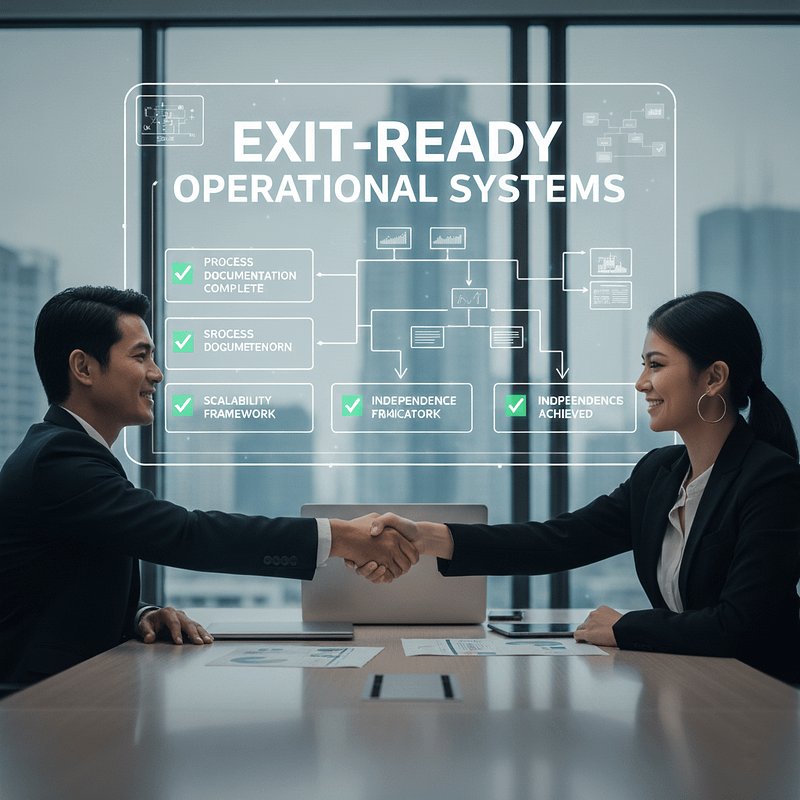
They examine: ✦ Process documentation completeness: Do SOPs exist and get followed? ✦ Knowledge management systems: Is institutional knowledge captured or locked in people’s heads? ✦ Team capability independence: Can the team deliver without founder involvement? ✦ Quality control frameworks: Are standards documented and measurable? ✦ Crisis response protocols: Are there documented procedures for handling problems?
Every gap they discover becomes leverage to reduce your valuation or grounds to walk away entirely.
But here’s what transforms valuations: businesses with comprehensive documentation, systematic knowledge capture, and true operational independence command premium multiples.
Why?
Because buyers aren’t just acquiring your current revenue, they’re acquiring the systems that generate that revenue predictably, regardless of who’s running the business.
The Bottom Line on Exit-Ready Documentation
✦ Mental bandwidth isn’t scalable, documented systems are
Your brain has limits.
Your documentation doesn’t.
Every process you capture, every lesson you document, every SOP you create removes cognitive load from your daily operations and adds transferable value to your business.
✦ Founder dependency is the most expensive operational risk
Buyers discount founder-dependent businesses by 30-50% because the operational risk is quantifiable.
The moment you step away, delivery quality becomes uncertain.
Documentation eliminates this risk and protects your valuation.
✦ Exit-ready means vacation-proof, not just profitable
If you can’t take three months off without operational chaos, you don’t have an exit-ready business.
You have a high-paying job.
Documentation creates the operational independence that defines true business value.
✦ Systems-dependent beats owner-dependent every time
Buyers pay premiums for predictable delivery systems, not brilliant founders.
Transform your operational knowledge into documented systems, and you’ve created an asset that functions independently and sells at premium valuations.
“Transform chaos into systems that boost value, cut owner dependence, and create exit options.”
From Mental Overload to Premium Exit Value
Every time you say “I’ll keep it in mind,” you’re choosing mental overload over business value. The shift from founder-dependent operations to systematic documentation isn’t just about reducing stress, it’s about building exit-ready business value.
M&A activity is surging, but most service businesses aren’t ready because their operational excellence exists in founders’ heads, not in documented systems. The businesses that command premium valuations? They’ve invested in comprehensive documentation, knowledge capture, and operational independence.
The question isn’t whether you should document your operations. The question is: what’s the cost of not documenting?
➤ Ready to transform mental overload into exit-ready operations? Book your Crisis Prevention Audit and discover where founder dependency is costing you business value.
➤ Want to understand your exit readiness? Explore our Exit Strategy packages designed to transform chaos into systematic operations that premium buyers reward.
➤ Building towards a premium exit? Discover how enterprise-level documentation systems create the operational independence that maximises business valuations.
We use cookies to improve your browsing experience, analyze site traffic, and personalize content. You can choose to accept all cookies, reject non-essential ones, or customize your preferences. For more details, please review our Privacy Policy.
Essential
Always active
These cookies are necessary for the website to function properly and cannot be disabled.
Preferences
The technical storage or access is necessary for the legitimate purpose of storing preferences that are not requested by the subscriber or user.
Analytics
The technical storage or access that is used exclusively for statistical purposes.Used to collect anonymous data on how visitors interact with our website to help us improve performance and user experience.
Marketing
Used to track visitors across websites to deliver relevant advertising and measure campaign effectiveness.